The Cash Flow Tracker
A simple way to see what's coming in, what's going out, and whether it's going where you want.
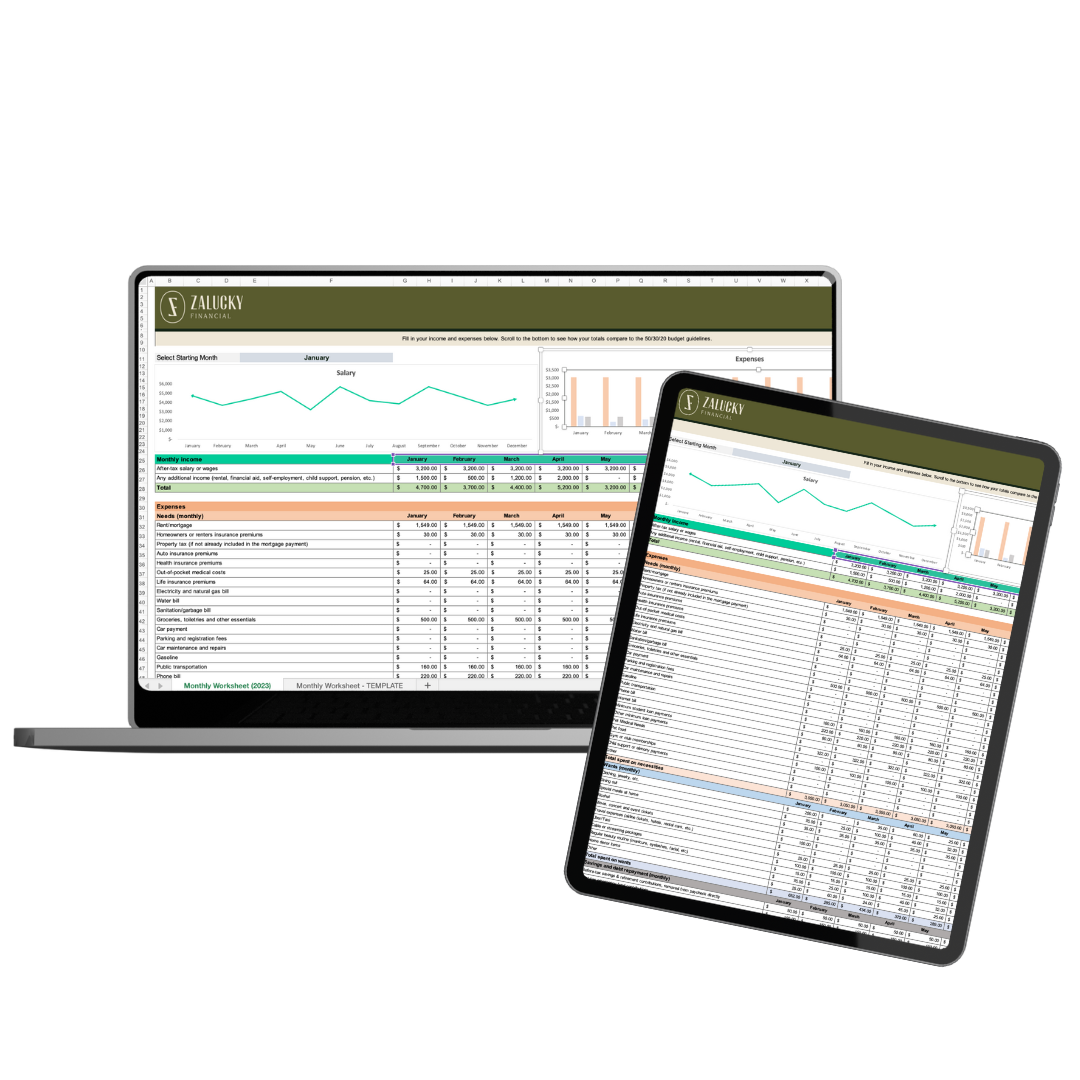
- One page, in Excel or Google Sheets
- No subscription. No bank connection.
- Set up in about 15 minutes
One-time payment · Yours forever, including updates
You're not bad with money.
It's that nothing shows you the full picture.
You earn a good income. You couldn't say where it went last month.
You've downloaded the money apps. They are so overwhelming.
You've tried the free budget templates. They're in your downloads folder, abandoned.
You check your balance bracing for it, or avoid it altogether.
Keeping a budget feels like a diet.
All restriction, no clarity, and you end up quitting every time.
That's not a discipline problem. Nobody gave you a simple way to see where your money is going.



A few minutes a month.
The sheet does the rest.
Enter what you earn.
Salary, side income, anything irregular.
Enter what you spend.
Use existing categories or add your own easily.
See where you land.
Against the 50/30/20 guideline, in color, instantly.
See exactly where it went
Sample month · $4,700 inEvery formula is already built. No tabs to juggle. No math. The charts update the moment you type.
What people say after they use it
It gave me real visibility into where my money goes. I learned I can save more than I ever realized.
Ava
Now we're seeing the areas where changes are worth making, and we're excited to keep using it.
Chandni
A great first step to working through goal setting, catered towards my particular needs and personal ambitions.
Jenna
Your bank login stays yours
Apps are good at automation. Connect them to your bank and they do the rest. That’s fine, if you ever remember to check. The Cash Flow Tracker builds awareness: fifteen minutes a month with your own numbers helps you notice where your cash is flowing.
| Apps | This | |
|---|---|---|
| Your data | Their servers | Your Drive |
| Bank access | Required | Never |
| Cost | ~$100/year, forever | Once |
| What it does | Watches | Shows |
The Cash Flow Tracker is for you if…

You earn well and still feel behind.
The number is fine. The clarity isn't.
You want to understand your money, not just log it.
A running total tells you what happened. This tells you what it means.
You want clarity, not a lecture.
No guilt, no shame, no system to maintain.
You've quit before.
Apps, templates, spreadsheets. This one is simple enough to keep.



One-time payment · Excel & Google Sheets included

Fifteen years on Bay Street and Wall Street.
I built the Cash Flow Tracker for the woman the industry keeps underestimating.
I spent 15 years in the rooms where the big financial decisions get made. Then I left to do the opposite of what that industry usually does to women. Zalucky Financial is no-commission, education-first consulting, because I watched too many smart, capable women get talked down to about their own money.
Clarity isn't about being a math person. It's about seeing your money plainly and making decisions from clarity, not worry.
I built this for the woman who's doing well on paper and still wonders if her money is working hard enough. Not because she needs a lecture about lattes. Because nobody ever gave her a clear, simple way to see the whole picture.
— Roxy Zalucky
Can’t I just grab a free money tracker?
You can. There are thousands, and some of them are fine. I know, because I tried them. When I built the Cash Flow Tracker, I downloaded the free templates and the cheap Etsy ones, and I used them the way a client would.
Most hand you a blank grid and wish you luck. They ask you to log what you spent without ever showing you what it means, and there's no one to ask when your numbers don't look like the example.
So I built the one I actually wanted: sorted into needs, wants, and savings from the first cell, measured against the 50/30/20 guideline, and if you get stuck, you email me. A real person answers.
If a free template already has you clear on what your money is doing for you, use it. Truly. If you've downloaded three and abandoned all of them, the Cash Flow Tracker has you covered.
Everything, for one payment
$27
No subscription · No renewals · Yours forever
- The spreadsheet, in Excel and Google Sheets
- Automatic 50/30/20 tracking with live charts
- Cross-border categories (RRSP, TFSA, 401(k), Roth)
- Setup guide and video walkthrough, up and running in 15 minutes
- Fully customizable, because your life isn't a template
- Future updates included
- Email support from Roxy, a real person answers
Available in dollars, pounds and euros
Frequently Asked Questions
Is this a subscription?
No. You pay once and the Cash Flow Tracker is yours, including future updates. There's no recurring fee and nothing to cancel.
Do I need to be good with spreadsheets?
No. If you can type a number into a box, you can use this. Every formula is already built. The setup guide and the video walk you through each step, and you'll be up and running in about fifteen minutes.
Do I have to connect my bank account?
No, and you can't. That's on purpose. Nothing is linked, nothing syncs, and no third party ever sees your private data.
How much time does this take each month?
Most people spend about 15 minutes at the end of the month reviewing where things landed. It's designed to be light enough that you'll actually keep doing it.
Why pay for this when there are free budget templates everywhere?
Fair question. There are, and some of them are fine.
Before I built this, I downloaded a stack of the free ones and bought the cheap Etsy ones, and tried to use them. Most of them just give you a grid. The sheet tracks what you spent but never shows you what it means, and there's nobody to email if you get stuck.
So I built the version I wished existed: already sorted into needs, wants, and savings, measured against the 50/30/20 guideline, and backed by an actual person. Me.
If a free template already has you clear, use it. But if you've tried a few and they're sitting abandoned in your downloads folder, you’re who I made this for.
What if I get stuck?
Email Roxy directly at [email protected]. A real person answers.
Does this work in Excel or Google Sheets?
Both are included. Use whichever you already have open.
I'm in Canada. Does this work for me?
Yes. The categories cover Canadian accounts, including RRSP and TFSA contributions, and the currency is yours to set. The 50/30/20 guideline works the same regardless of where you bank.
I'm in the US. Does this work for me?
Yes. 401(k), IRA, Roth: the categories are there, and you can add or rename anything that doesn't match your situation.
What currency does it use?
The Cash Flow Tracker is available in dollars, pounds, and euros. You pick the version you need at download.
What is the 50/30/20 rule?
It's a simple, widely used way to balance your money: roughly 50 percent of your after-tax income goes to needs, 30 percent to wants, and 20 percent to savings and debt repayment. Needs are the things you can't skip, like housing, groceries, insurance, and transportation. Wants are the things that make life good, like dining out, travel, and clothes. The last 20 percent builds your future.
The Cash Flow Tracker tracks all three automatically and shows you where your real spending lands against the guideline, so you can see the gap without doing the math.
Is the 50/30/20 rule actually a good approach?
It's a starting point, not a law. Its strength is that it's simple enough to actually follow, and it gives you a benchmark instead of a vague sense that you should be saving more. If your rent eats 60 percent of your income, the guideline won't shame you, it'll just show you clearly what that means for everything else. That clarity is the point. What you do with it is a strategy conversation.
How is this different from an app like YNAB or Monarch?
The apps sell you on automation, but that automation is where they fall apart. They miscategorize constantly. A charge lands in the wrong bucket, or disappears into one you'll never think to check, and fixing it is its own frustrating little project.
The Cash Flow Tracker works the other way. You enter your own numbers, which takes a few minutes, and in exchange nothing is ever miscategorized, buried, or wrong, because you put it where it goes. Typing it in yourself is how you notice what's happening with your money, and it's how you stay in control of the picture instead of the app.
You also own your file instead of storing your financial life on a company's servers, and you pay once instead of roughly a hundred dollars a year, forever.
Will this work if my income changes month to month?
Yes. There's room for multiple income sources, including salary, side income, rental income, and anything irregular, and each month is tracked separately so an uneven year still shows a clear pattern over time.
Can I use this with my partner?
Yes. It's one file, so you can share it or keep it in a shared Drive folder and both work in it.
Will this fix my whole financial life?
It won't do it for you, but it will show you the truth clearly, which is where every real change starts. Many people use the Cash Flow Tracker as their first step, then work with Roxy one-on-one when they want a fuller strategy.
You don't need more willpower.
You need to see your money clearly.
Not another app. Not stricter rules you'll abandon in three weeks. Just a clear look at where your money goes, and what that means for the life you're building.
One-time payment · No subscription · No bank connection